



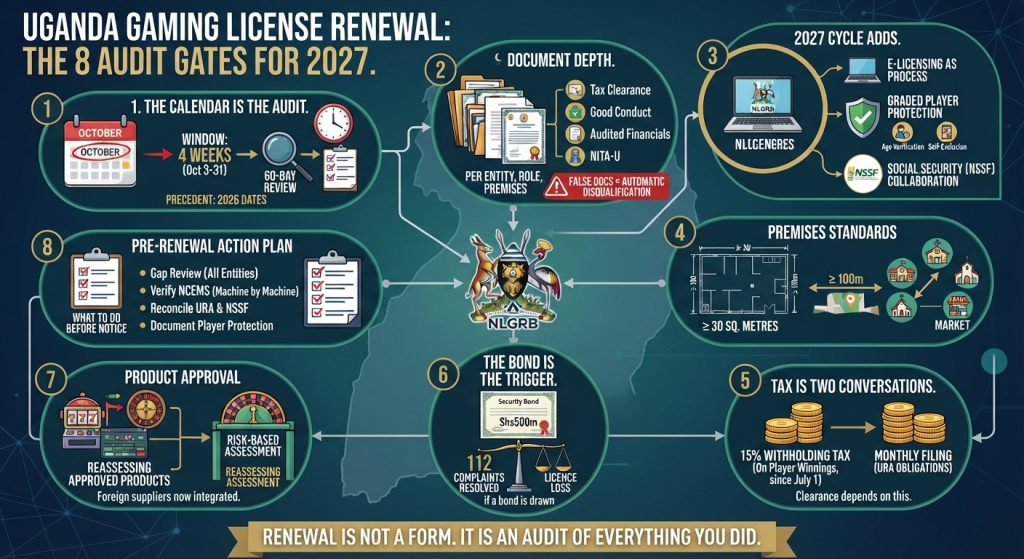
Uganda’s licence renewal window has never really been about the form. It is a point-in-time audit of everything you did for the previous twelve months — and the Board spent 2026 adding things to audit. Most operators will discover that in the last week of the window.
Here is how renewal season actually works in this market.
A notice goes up. A window opens for roughly four weeks. Operators who kept clean records file through the e-licensing platform in a few days. Everyone else spends the final nights chasing a tax clearance certificate, a certificate of good conduct for a shareholder who lives abroad, and an auditor who is on leave.
Then the window closes. In the last cycle, the National Lotteries and Gaming Regulatory Board left no room for interpretation: the renewal window closes on the stated date, and applications submitted after it will not be accepted. On evaluation, the Board was equally plain — only complete applications will be evaluated.
Not reviewed late. Not evaluated.
1. The Calendar Is the Part Operators Get Wrong
The 2026 cycle is the precedent worth studying. Applications opened on 3 October 2025 and closed on 31 October 2025. The Board then said it would process all applications within 60 days.
Read that timeline again. Whether you trade in January is decided inside a 30-day window in October, and then sits with the Board for two months.
The NLGRB has not published the 2027 window dates in a public notice as of this writing. That is not a reason to wait. It is a reason to treat October as the working assumption, because the 2026 calendar is the only precedent you have.
Which means the work that actually decides your renewal is already behind you or already late:
- Certificates of good conduct for directors and shareholders — police turnaround is not a same-week exercise, and it is worse for non-resident directors
- Audited financial statements and annual returns — your auditor needs lead time you have not given them
- NITA-U certification confirming data and security compliance — check the expiry date today, not in week four
- NCEMS integration — every electronic gaming machine and platform connected, verifiable, before approval, not promised in a covering letter
2. It Is Not Nine Documents. It Is Nine Per Entity, Per Role, Per Premises.
The published requirement set from the last cycle is the clearest picture operators have of what renewal demands. The core file for an operator:
- Tax clearance certificates
- Certificates of good conduct for directors and shareholders
- Audited financial statements and annual returns
- A business plan for the licence year, including corporate social responsibility initiatives
- Employee training plans
- NITA-U certification on data and security compliance
Then it branches by category, and this is where thin applications get caught:
- Franchisees: certificates of incorporation, memoranda and articles of association, franchise agreements, lists of declared premises, and the electronic gaming machines to be connected to NCEMS
- Key employees: certificates of good conduct, employment contracts, academic qualifications, competence statements and proof of relevant experience — and your Chief Finance Officer must hold a CPA qualification
- Machine and software providers: authorisation letters, machine lists, software versions, user manuals, certification documents, and data protection and privacy policies
- New games: game rules submitted for approval
- Casinos: registration as accountable persons with the Financial Intelligence Authority, plus annual anti-money laundering and counter-terrorism financing compliance reports
One line in the Board’s notice deserves to be printed and taped to a wall: false documentation will lead to automatic disqualification and prosecution. The temptation in a compressed window is to submit something that looks finished. That is the single most expensive shortcut available to you.
3. Three Things the 2027 Cycle Adds
At its annual pre-licensing stakeholder engagement on 25 September 2026 at Royal Suites in Bugolobi, the Board set out what is changing. Three items matter commercially.
Electronic licensing becomes the process, not a channel. The Board has said the 2027 framework involves changes including an e-licensing system, part of a broader move to digital, data-driven oversight alongside NCEMS. A portal does not forgive a missing document. It timestamps it.
Player protection moves from a policy page to a graded expectation. Board Chairperson Kenneth Kitariko named three expectations of operators: full compliance with applicable laws and licence conditions, accurate and timely regulatory reporting, and a firm commitment to player protection. He was explicit that a gaming licence carries legal, financial and social responsibilities rather than being an administrative formality. Chief Executive Denis Mudene Ngabirano put the Board’s objective this way: “Our objective is to create a regulatory environment that protects the public and government revenue.” He asked operators to strengthen age verification, self-exclusion and responsible gaming messaging specifically.
Social security entered the room. The Uganda Revenue Authority and the National Social Security Fund both attended the engagement. A proposed NLGRB–NSSF collaboration, discussed with Brendah Arinda, NSSF Senior Manager for Partnerships and Business Development, could bring an estimated 24,000 gaming sector employees into social security coverage. Operators who have been informal about staff contributions should read that as a compliance signal, not a welfare announcement.
4. Your Premises Form Part of the Application
Licensed premises face pre-licensing inspections, and the standards are physical and measurable:
- A minimum floor area of 30 square metres
- Secure facilities and measures to prevent access by minors
- Accessibility, visible display of licences, and responsible gaming messaging on site
- Location at least 100 metres from schools, markets and places of worship
That last one is not a formality in Ugandan trading centres, where the economics of footfall push shops toward exactly the places the rule keeps them away from. A site that fails the 100-metre test is not a fine. It is a declared premises you cannot license.
5. Tax Compliance Is Now Two Conversations, Not One
Since 1 July 2026, a 15 per cent withholding tax applies to betting and gaming winnings under Section 131 of the Income Tax (Amendment) Act, 2026, which President Museveni assented to on 20 August 2026 after returning an earlier version to Parliament. The tax applies to the player’s net gain — payout minus stake — and payers must deduct at source.
Two details operators keep getting wrong. The land-based casino exemption that appeared in the initial bill was removed from the final law. And winnings paid by the licensed national lottery operator remain outside the tax.
URA already requires licensed operators to deduct withholding tax before paying customers and to file monthly. The NLGRB and URA sat down with operators on 11 September 2026 specifically on implementation, where Mudene urged the sector to work with regulators on practical solutions and to adopt technology that supports transparency and accountability.
Now connect it to renewal: a tax clearance certificate is a renewal document. Which makes a URA arrears position a licensing problem, not an accounting one.
6. The Bond Is the Quietest Clause in Your Licence
Licensed betting operators must lodge a security bond or bank guarantee of Shs500m to hold a licence. Most operators treat it as locked capital and forget it exists.
It is better understood as a trigger. Where an operator fails to pay a legitimate winning claim, the Board can draw on that bond to compensate the player. Mudene has described the consequence directly: once the bond is used, the operator loses the licence.
The volume behind that clause is real. The Board resolved 112 of 125 payout complaints in a recent financial year — close to 90 per cent — on disputed claims totalling Shs2.6bn. Mudene credited operators as being very responsive, especially on financial matters. That responsiveness is the system working. A single unresolved refusal to pay is how an operator discovers the other path.
7. Product Approval Is a Separate Gate Now
In evidence to Parliament’s Committee on Commissions, Statutory Authorities and State Enterprises in August 2026, the Board confirmed it has developed and implemented the Uganda Games Classification and Product Approval Framework — a risk-based system for approving, monitoring and reassessing gaming products.
Note the third verb. Reassessing. A product approved once is not approved permanently.
The Board also told the Committee it had reconfigured the licensing platform to accept eligible foreign applicants, after four foreign software providers had to be approved manually because the digital system initially required Ugandan Tax Identification Numbers and URSB registration numbers. If you onboard foreign suppliers, that fix is worth confirming before you depend on it.
8. What to Do Before the Notice Goes Up
- Order the slow documents today — good conduct certificates and the audit are the two items that cannot be accelerated by effort in week four
- Run a document gap review against the full published list — by entity, by key employee, by premises, by supplier. Assume nothing carries over
- Verify NCEMS connectivity machine by machine — not platform-wide, machine by machine, with evidence
- Reconcile with URA before you request clearance — including the withholding tax position since July
- Put player protection in writing — age verification, self-exclusion, responsible gaming messaging, staff training records. The Board has said it will assess commitment, and commitment is evidenced or it is claimed
- Check your staff NSSF position — before someone else does
- Measure your premises — floor area and the 100-metre distances, at every declared site
The harsh truth is that renewal in Uganda has long been treated as an administrative season — a month of paperwork between twelve months of trading. That reading made sense when the regulator could only see what you told it.
It cannot see only that any more. NCEMS carries transaction-level data in real time. Over 7,000 illegal machines have been seized and more than 6,000 destroyed after court approval. Twenty-three illegal online operators have been blocked, with 24 prosecutions and 21 convictions recorded. A regulator with that enforcement record and that data position does not need renewal season to find out who was compliant.
Renewal is just where it writes the finding down.
Gaming Port covered the Board’s pre-licensing engagement when it happened. Read it here: NLGRB Opens 2027 Licensing Cycle Talks as Gaming Operators Face Renewed Focus on Player Protection.

